
The UK entered WW2 on 3 September, 1939. Eighty years after the war’s end, few people know that a British island’s unique language was used as a clandestine code during Nazi occupation
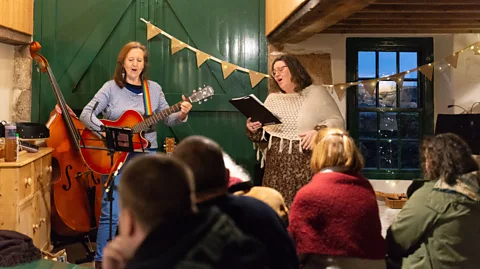
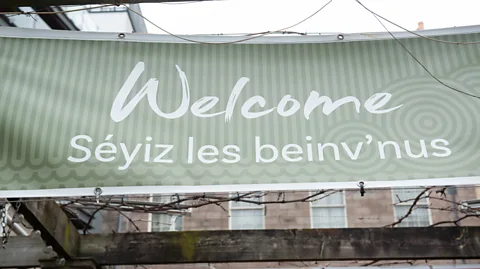
“Bonsouair! Seyiz les beinv’nus!” announced Jo Thorpe, as she stepped up to the microphone and spread her arms in welcome. “Or for anyone who’s not from Jersey, good evening and welcome! We’re thrilled to see you tonight, and we hope you enjoy the show.”
The lights dimmed, and her band, Sonneux, started playing. Accompanied by violin, double bass, guitar and recorder, Thorpe began to sing a familiar folk melody – only there was something surprising about her tune. Though it sounded like she was singing in French, in fact, she was singing in another language entirely: Jèrriais, Jersey’s native language.
“In Jersey, we call this a veil’ye,” she explained during a mid-show break, handing me a bowl of bean crock, a traditional, hearty island stew. “It’s an evening of singing, music and storytelling, where people read, perform and share memories. Before radio and TV, a veil’ye was how people socialised. Every village had them. They were part of life. But the tradition died out, so we decided to bring them back. And of course, we couldn’t do that without Jèrriais.”
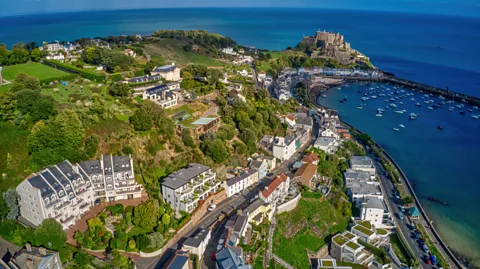
Jersey is the largest of the Channel Islands, an archipelago of six inhabited islands (and many more uninhabited ones) scattered over the English Channel, just over 14 miles from the French coast. Despite its proximity to France, it’s actually a British Crown Dependency, and as such, the island has two official languages: English and French. But it also has Jèrriais.
Linguistically, Jèrriais’s closest relative is Norman French, a dialect that dates back to the days when Normandy was still its own independent kingdom, and which incorporates many words from Old Norse, a legacy of the Normans’ own Viking ancestry. Jèrriais shares much in common with the other languages of the Channel Islands, including Guernésiais (Guernsey) and Sercquiais (Sark), which are still spoken by a handful of people, and Auregnais (Alderney), which died out in the late 19th Century.
The first written record of Jèrriais dates from the 12th Century and the poet Wace, whose works Roman de Brut and Roman de Rou represent the earliest extant examples of the language – although Jèrriais was undoubtedly being spoken on the island long before Wace first put quill to parchment. As recently as the 1930s, Jèrriais remained the mother tongue for most Jersey-born people, but not everyone spoke quite the same version of the language. Since roads were poor and most islanders rarely travelled beyond their own home parish, every area of the island developed its own words, phrases and accents, which were often entirely different from those of their neighbours – an extraordinary fact on an island that measures just nine miles by five.
Today, however, it’s a different story. According to the Endangered Languages Project, Jèrriais is a language on the brink. In the 2002 census, only 15% of islanders said they understood at least some Jèrriais words; today it’s thought that figure is closer to 5%. Fluent speakers are even rarer; there are now fewer than 500 native Jèrriais speakers left, mostly in their 70s and 80s.
Among them is Francois Le Maistre. Now 87, he grew up in the parish of St Ouen, in the island’s west. Like most of his friends, he spoke solely Jèrriais at home; his father, Frank, compiled the first official Jerriais dictionary, published in 1972. It was only once he went to school that Le Maistre spoke English for the first time – and it came as a rude awake.
“I started school in 1944,” he recalled. “I wasn’t quite six and a half and I didn’t know a word of English. All my classmates were the same. And we all had to learn English pretty darn quick, because in the 1940s and ’50s, if you went to school and spoke Jèrriais, it was forbidden. If we spoke in Jèrriais…” he broke off and made a slapping sound with his hand. “It didn’t matter which school you went to. Jèrriais was seen as a peasant language, a language spoken only by poor people. That was the attitude from all the teachers, even the ones that spoke Jèrriais. It was really very sad.”
And yet, around the same time Le Maistre was starting school, Jèrriais was also playing a vital role in ensuring the island’s survival. During World War Two, the Channel Islands had the dubious honour of becoming the only part of the British Isles to be occupied: German troops landed on Jersey in June 1940 and remained until May 1945. With the British government focused on protecting the mainland from invasion (the summer of 1940 also marked the height of the Battle of Britain), the Channel Islands had little hope of rescue. Soon enough, food shortages, rationing, forced labour, imprisonment and even deportation became part of everyday life.
Instead of taking up arms, islanders found other, subtler ways to resist. They engaged in a campaign of passive resistance, and Jèrriais became central to their efforts. With its complex vocabulary and regional variations, the language was all but impossible for outsiders – even French-speaking Germans – to follow. As such, it made the perfect secret code, and islanders increasingly used it to exchange information, make clandestine plans against their occupiers and, occasionally, even mock their them right under their noses.
Jèrriais continued to be used as a secret language for passing messages for the rest of the war
“Jèrriais articles at the beginning of the occupation managed to get through resistance messages,” explained Geraint Jennings, a linguist, scholar and Jèrriais expert who works at L’Office du Jèrriais to promote the language. “Articles openly printed that it’s best to speak Jèrriais so ‘certain people’ won’t be able to understand it – IE the Germans! Of course, they soon cottoned on to that and clamped down with censorship, but Jèrriais continued to be used as a secret language for passing messages for the rest of the war.”
Ironically, despite its wartime role, the use of Jèrriais declined at an alarming rate after liberation in 1945. Like many of Britain’s minority languages, such as Manx, Gaelic, Welsh and Cornish, Jèrriais was derided as a language spoken only by the uneducated, and it had been in gradual decline since the late 19th Century – a trend that accelerated rapidly after the end of WW2.

“There was a feeling that English was the future,” Jennings said. “It was socially desirable to bring up English-speaking children. Speaking anything but English marked you out as a peasant. People were made to feel ashamed. They were ridiculed. There was a perception amongst native Jèrriais speakers that this is our language but it’s a thing of the past. And we’ll die with it.”
People were made to feel ashamed. They were ridiculed. There was a perception amongst native Jèrriais speakers that this is our language but it’s a thing of the past
That’s very nearly what happened. Within a generation of the war, the majority of schoolchildren no longer spoke more than a few words, and by the 1980s and 90s, the language had almost completely disappeared from everyday use. Suddenly, the island faced the very real prospect that Jèrriais could disappear altogether – just as its sister language, Auregnais, had a century before.
Since then, a concerted campaign has been made to bring the language back from the precipice. From 1999, when L’Office du Jèrriais was formed, the language has enjoyed a rapid resurgence. Over the last decade, the development of an education programme means all Jersey children can learn the language at school. Adult courses and language cafes have allowed older residents to learn the basics or brush up their vocabulary. Road signs and visitor sites are all now multilingual (in English and Jèrriais) to increase the language’s visibility. And people all over the world have begun to rediscover the language, using L’Office du Jèrriais’ online learning website, Learn Jèrriais, as well as language platforms like Linguascope and uTalk where Jèrriais has also been made available. Encouragingly, there was a huge uptick in interest during the Covid-19 pandemic.
Most importantly of all, Jèrriais achieved a major milestone in 2019 when, for the first time in its history, it was adopted by the island’s government, the States of Jersey, as an official language alongside English and French.