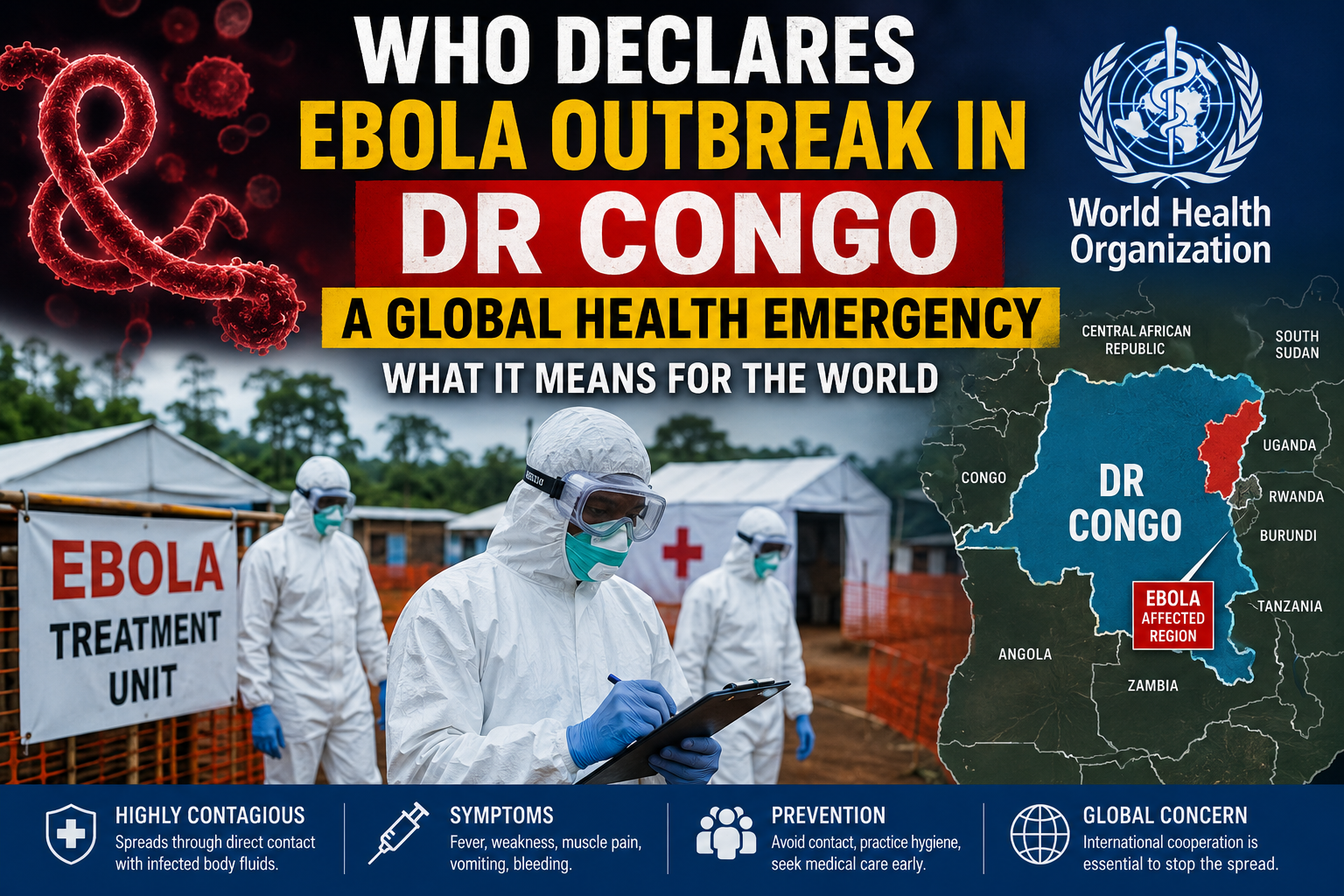

WHO Declares Ebola Outbreak in DR Congo a Global Health Emergency: What It Means for the World


When the World Health Organization raises the alarm and labels a crisis as a global health emergency, the world listens. This time, the spotlight is on Democratic Republic of the Congo, where a fresh surge of Ebola virus disease cases has triggered international concern. The declaration is not just a headline — it’s a signal that the situation has the potential to cross borders, disrupt health systems, and demand coordinated global action.
The DR Congo a situation is serious not only because of the deadly nature of Ebola, but also because of the region’s fragile healthcare infrastructure, population movement, and the risk of international spread. For many people outside Africa, this may feel like a distant problem. In reality, history has shown that infectious diseases do not respect borders. What begins in one remote province can quickly become a global threat if not contained swiftly.
This article breaks down what this declaration really means, why the world should care, and how global preparedness is being tested once again.
Why the WHO’s Global Health Emergency Declaration Matters
A Public Health Emergency of International Concern (PHEIC) is the highest level of alarm the WHO can raise. It is reserved for extraordinary events that pose a public health risk through international disease spread and may require a coordinated response. When the WHO makes this declaration regarding DR Congo a crisis, it activates funding channels, mobilizes international medical teams, and urges countries worldwide to step up surveillance and preparedness.
This is not the first time Ebola has surfaced in DR Congo. The country has faced multiple outbreaks over the years. However, each outbreak presents unique challenges. Conflict zones, remote villages, misinformation, and mistrust of health authorities make containment incredibly difficult. Healthcare workers often struggle to reach affected communities, and delays in response can allow the virus to spread silently.
The declaration also pushes neighboring countries into high alert. Airports enhance screening, hospitals review isolation protocols, and governments issue travel advisories. Global laboratories begin preparing for testing, and vaccine stockpiles are assessed. In simple terms, the world shifts from passive observation to active prevention.
For everyday people, this may translate into increased news coverage, travel checks, and health advisories. But behind the scenes, a massive global coordination effort begins — one designed to stop Ebola before it becomes a pandemic-scale crisis.
Understanding the Ebola Threat and Why DR Congo Is Vulnerable


Ebola is not like common viral infections. It spreads through direct contact with bodily fluids of infected individuals and has a high fatality rate if untreated. Symptoms begin like flu — fever, fatigue, muscle pain — but can escalate rapidly into internal bleeding and organ failure. Early detection and strict isolation are crucial.
The reason DR Congo a outbreak raises special concern is due to several on-ground realities. Many affected regions are remote, with limited roads and healthcare facilities. Communities often rely on traditional healing practices, and misinformation can lead people to hide symptoms rather than seek treatment. Additionally, ongoing security issues in certain provinces make it dangerous for medical teams to operate freely.
Another factor is cross-border movement. People regularly travel between DR Congo and neighboring countries for trade and family connections. Without proper screening, Ebola can cross borders silently. This is why the WHO’s declaration triggers regional coordination, not just local action.
Vaccines and treatments exist today that were not available during earlier Ebola crises. However, deploying them effectively requires trust, logistics, and trained personnel — all of which are challenging in unstable environments. The DR Congo a situation is a reminder that medical solutions alone are not enough; social cooperation and infrastructure matter just as much.
What This Means for the Rest of the World
For countries far from Central Africa, the immediate risk may seem low, but the implications are significant. International travel, global trade, and migration mean that diseases can spread faster than ever. The WHO’s declaration encourages nations to revisit their emergency response plans, ensure hospitals are ready, and educate healthcare workers about Ebola protocols.
Airports may increase passenger screenings, especially for travelers from affected regions. Hospitals review isolation wards and protective equipment supplies. Governments may issue advisories to citizens traveling abroad. These measures are preventive, not panic-driven.
The DR Congo a emergency also highlights a larger issue — global health equity. Outbreaks often become global threats because the countries where they begin lack resources for rapid containment. Supporting healthcare systems in vulnerable regions is not charity; it is a global safety strategy.
For the public, the key takeaway is awareness, not fear. Ebola does not spread through the air like flu or COVID-19. It requires close contact. The chances of random infection outside affected zones are extremely low. However, staying informed through reliable sources and understanding how outbreaks are managed helps reduce misinformation and panic.
This declaration is a test of how well the world has learned from past outbreaks. Rapid communication, transparent reporting, vaccine deployment, and international cooperation are now the pillars of response.
The Road Ahead: Containment, Cooperation, and Preparedness
Containing Ebola in DR Congo will require more than medicine. It demands community engagement, secure access for health workers, proper funding, and global solidarity. The WHO’s emergency declaration is essentially a call for unity — asking countries, organizations, and health agencies to work together before the situation escalates.
In the coming weeks, efforts will focus on contact tracing, vaccination drives, public awareness campaigns, and strengthening treatment centers. International experts may be deployed to support local teams. Data sharing between countries will increase to monitor any potential spread.
The DR Congo a outbreak serves as a stark reminder that global health security is interconnected. An outbreak anywhere can become a threat everywhere if ignored. But with swift action, transparent communication, and coordinated effort, Ebola can be contained — as it has been before.
For the world, this is not just news. It’s a lesson in preparedness, cooperation, and the importance of strong healthcare systems across every continent.