

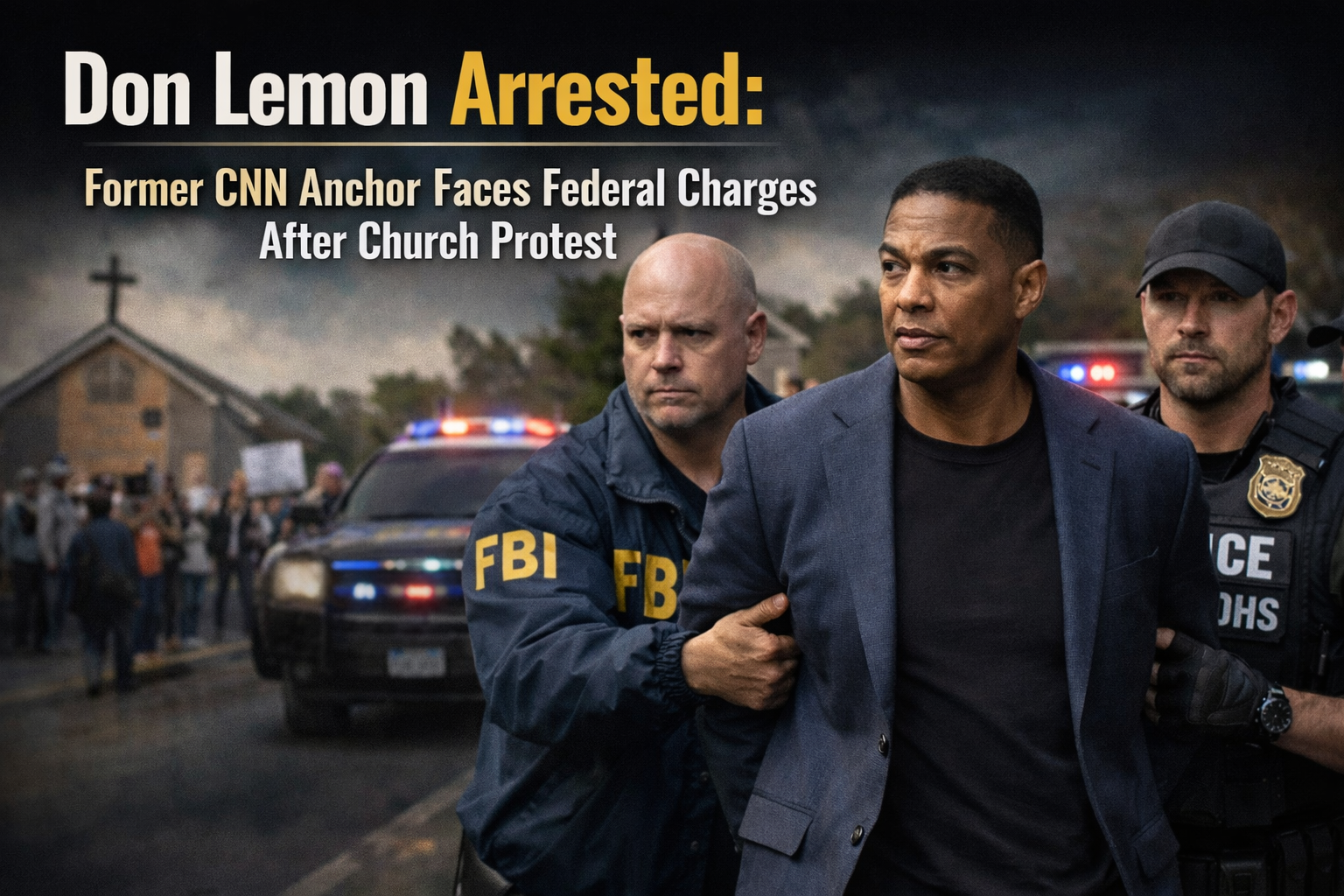

The shocking news that Don Lemon has been arrested has quickly become one of the most talked-about stories in U.S. media and political circles. The former CNN anchor, known for his outspoken journalism and decades-long career, is now facing serious legal scrutiny after a protest at a Minnesota church escalated into a federal case.
From questions about press freedom to debates over religious rights, the incident has triggered nationwide discussion. But what exactly happened, what charges does Lemon face, and what could this mean for journalism in America? Let’s break down the full story in a clear, engaging, and informative way.
What Happened? Don Lemon Arrested After Minnesota Church Protest
Don Lemon was arrested by federal agents in Los Angeles in connection with an anti-immigration enforcement protest that disrupted a church service in St. Paul, Minnesota. (Reuters)
Reports indicate that demonstrators entered the church during worship and chanted slogans critical of U.S. Immigration and Customs Enforcement (ICE). (AP News) The protest specifically targeted the church because one of its pastors was reportedly affiliated with ICE. (AP News)
Authorities claim Lemon played a role in the incident, while his legal team insists he was there strictly as a journalist documenting events.
Federal prosecutors have reportedly charged Lemon under laws related to civil rights conspiracy and obstruction of access to a place of worship, including the FACE Act. (Reuters) If convicted, the charges could potentially carry significant prison time. (New York Post)
Interestingly, the arrest sparked controversy because a magistrate judge had previously denied an arrest warrant, citing a lack of probable cause — yet prosecutors later secured indictments through a grand jury. (The Washington Post)
Federal Charges and Legal Battle: A Case That Could Shape Press Freedom
The legal situation surrounding Don Lemon is far from straightforward. On one side, the Justice Department argues that disrupting a religious service violates constitutional protections for worshippers. On the other, Lemon’s defense says the arrest represents a dangerous attack on the First Amendment.
His attorney emphasized that Lemon has been a journalist for roughly 30 years and was performing constitutionally protected reporting at the time. (EW.com)
Civil rights advocates and journalism organizations have also voiced concern, warning that arresting reporters who cover protests could threaten press freedom. (AP News)
Adding another layer of complexity, three other individuals — including an independent journalist — were arrested in connection with the same protest. (Reuters)
Meanwhile, officials defending the arrests say the government must protect religious gatherings from disruption. (AP News)
This clash highlights a broader national debate:
- Where does journalism end and participation begin?
- Can reporters face criminal charges simply for being present during protests?
- How should the law balance religious rights with freedom of the press?
Legal experts suggest the outcome could set a precedent for future cases involving reporters covering politically charged demonstrations.
Why the Arrest Is So Controversial
The story has gained traction not only because Don Lemon is a high-profile media personality, but also due to the political and social tensions surrounding immigration enforcement in the United States.
Critics argue the arrest reflects growing friction between the government and the media. Some observers even describe the case as part of a broader pattern of targeting journalists and political opponents. (Reuters)
Supporters of the legal action, however, maintain that no one — including journalists — is above the law when constitutional rights are allegedly violated.
Another surprising detail: Lemon was reportedly taken into custody while covering the upcoming Grammy Awards, making the arrest even more dramatic. (Los Angeles Times)
The timing amplified media attention and fueled intense discussion across social platforms and newsrooms.
Don Lemon’s Career and Public Profile
For those unfamiliar with his background, Don Lemon is one of America’s most recognizable television journalists. He spent 17 years at CNN before leaving the network in 2023 and later launching independent media projects. (Wikipedia)
Throughout his career, Lemon built a reputation for direct commentary on politics, race, and social justice — often placing him at the center of national debates.
That visibility is precisely why this arrest has become headline news worldwide.
What Happens Next? Court Appearance and Ongoing Investigation
Lemon is expected to appear in court as the legal process unfolds. (New York Post)
However, several key details remain unclear:
- Prosecutors have not fully disclosed all aspects of the indictment. (The Washington Post)
- Lemon maintains he had no affiliation with the protest group and was only documenting events. (AP News)
- The case continues to raise constitutional questions that may take months — or even years — to resolve.
Regardless of the verdict, experts believe the situation could influence how journalists operate at protests and politically sensitive events going forward.
Bigger Picture: Journalism, Protest, and Constitutional Rights
The arrest of Don Lemon goes beyond a single incident. It touches on fundamental democratic principles:
When these rights intersect, legal conflicts are almost inevitable.
Some analysts warn that aggressive prosecutions could discourage reporters from covering controversial stories. Others argue that clear legal boundaries are necessary to prevent chaos during demonstrations.
Either way, this case is shaping up to be a landmark moment in the evolving relationship between media and government authority.
The news that Don Lemon has been arrested marks a dramatic chapter in the career of a veteran journalist and raises serious questions about constitutional protections in modern America.
Was he exercising his right to report — or crossing a legal line?
The courts will ultimately decide. But one thing is certain: this case has already ignited a national conversation about journalism, accountability, and civil liberties.
As developments continue, the world will be watching closely.





I really enjoyed playing. bloodmoney 2 has some interesting mechanics that keep you coming back for more.
Wishing you a happy day, every day!