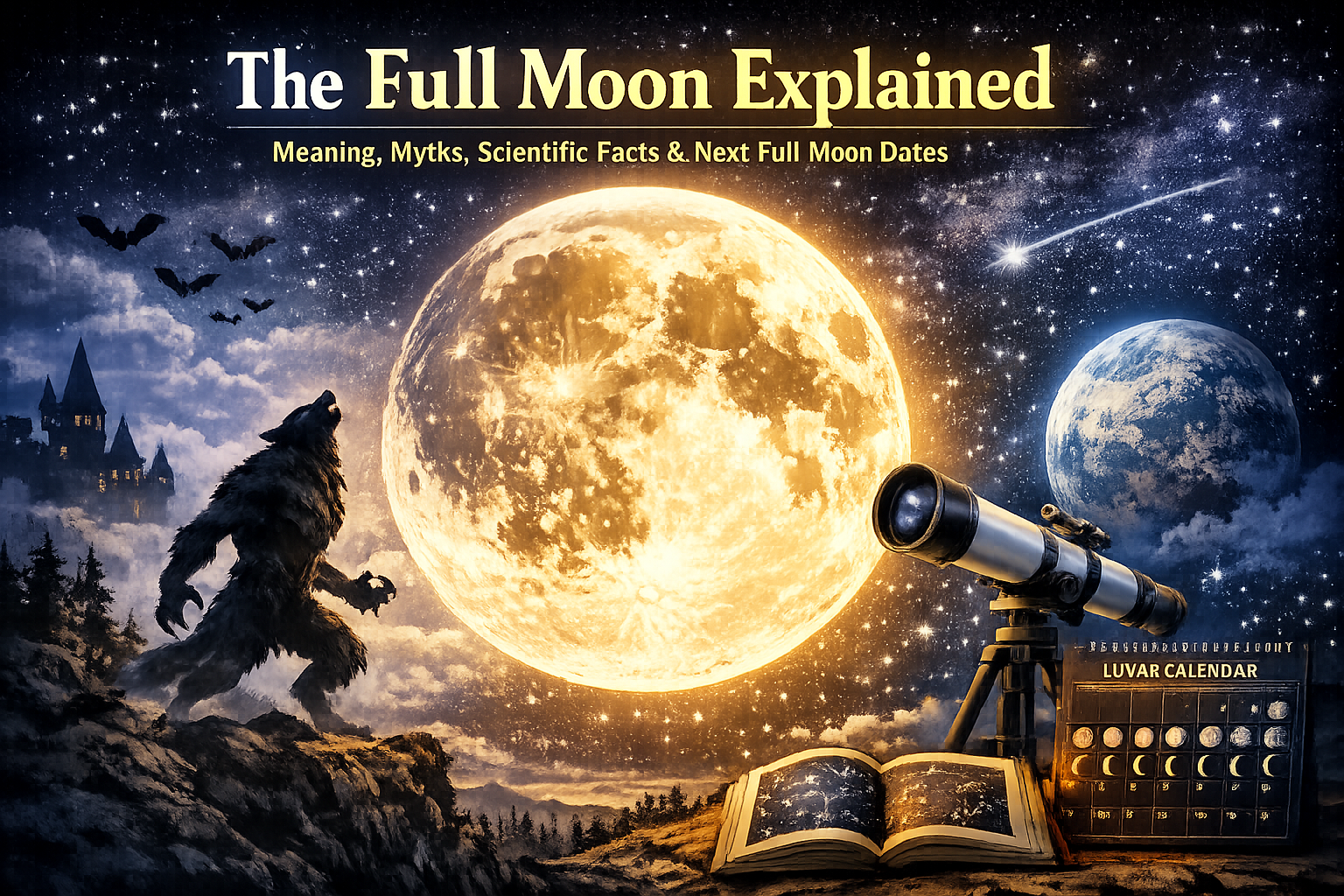

The full moon has fascinated people for thousands of years. Across different cultures and civilizations, it has inspired myths, legends, celebrations, and even scientific discoveries. Whether you are searching for information about the next full moon, wondering about tonight’s moon, or curious about the difference between a full moon today and the next new moon, understanding the lunar cycle can help you appreciate one of nature’s most beautiful phenomena.
. By the end, you’ll have a deeper understanding of Earth’s natural satellite and its influence on our planet.
What Is a Full Moon and Why Does It Happen?
This phase is one of the most recognizable and visually stunning stages of the lunar cycle.
The Moon does not produce its own light. Instead, it reflects sunlight. As the Moon orbits Earth, different portions of its sunlit surface become visible, creating the lunar phases. The complete cycle, known as a lunar month, takes approximately 29.5 days to finish.
Many people frequently search for terms like full moon today, tonight’s moon, and next full moon because lunar phases change continuously throughout the month. The exact timing of a full moon depends on astronomical calculations and can vary depending on your location. Understanding these phases can also help skywatchers plan stargazing sessions and observe celestial events more effectively.
Full Moon Myths, Cultural Beliefs, and Historical Significance
Throughout history, the full moon has played a significant role in folklore, religion, and cultural traditions. Ancient civilizations often viewed the Moon as a powerful symbol connected to fertility, harvests, spirituality, and transformation.
One of the most enduring myths is the belief that a full moon influences human behavior. The term “lunacy” itself originates from the Latin word “luna,” meaning Moon.
Some people believe that the energy of a full moon promotes reflection, emotional balance, and personal growth. While these beliefs are largely based on tradition rather than science, they continue to influence communities around the world.
Interest in the next new moon is also common because the new moon represents the beginning of a fresh lunar cycle. Together, the full moon and new moon mark important milestones in the lunar calendar and hold symbolic significance for many cultures.
Scientific Facts About the Full Moon and the Lunar Cycle
Despite the myths and legends, the full moon is a scientifically understood astronomical event. The Moon’s gravitational pull affects Earth’s oceans, creating tides. . These tides are higher and lower than normal, demonstrating the Moon’s measurable influence on our planet.
Another fascinating fact is that the Moon is gradually moving away from Earth at a rate of about 3.8 centimeters per year. Although this movement is extremely slow, it provides valuable insights into the long-term evolution of the Earth-Moon system. Scientists study the Moon extensively because it offers clues about the formation of our solar system and the history of planetary development.
Many people checking tonight’s moon may notice that the Moon sometimes appears larger near the horizon. This phenomenon, known as the Moon illusion, is actually a trick of human perception. The Moon’s physical size remains nearly the same, but our brains interpret it differently when it is viewed alongside buildings, trees, and landscapes.
Modern technology allows astronomers to accurately predict the timing of every lunar phase, including the next full moon and next new moon. Online lunar calendars and astronomy apps make it easy to track upcoming celestial events. Whether you are a casual observer or a dedicated astronomy enthusiast, following the lunar cycle can deepen your appreciation for the natural rhythms of the universe.
The next time you look at a full moon today or admire tonight’s moon, remember that you are witnessing a celestial event that has inspired humanity for thousands of years. While myths and folklore continue to add mystery and wonder, science provides a fascinating explanation of how and why these beautiful lunar phases occur. By understanding both the cultural significance and scientific reality of the full moon, we gain a richer perspective on one of the most captivating sights in the night sky.