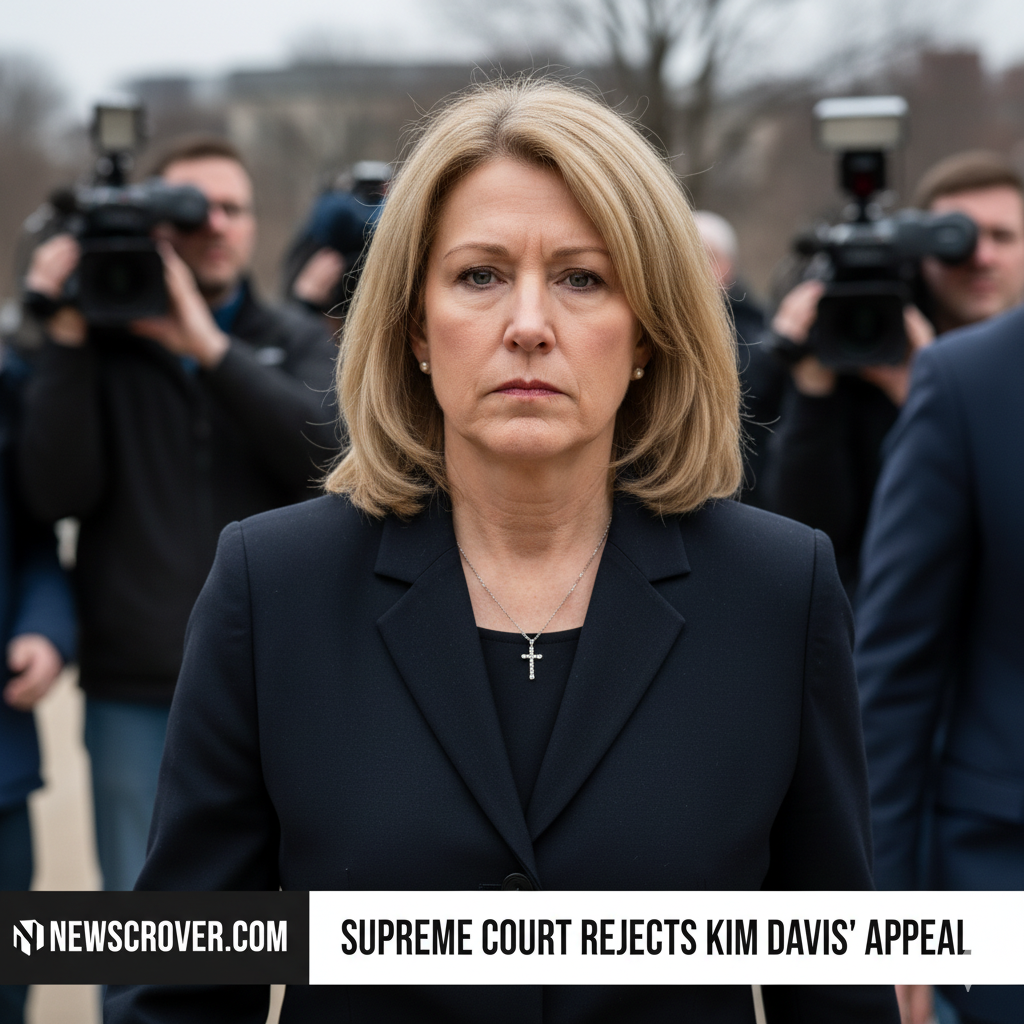

Supreme Court Rejects Kim Davis’ Appeal in Same-Sex Marriage Case
In a decisive move that reaffirms the constitutional right to same-sex marriage, the U.S. Supreme Court has declined to hear an appeal from Kim Davis, the former Kentucky county clerk who gained national attention in 2015 for refusing to issue marriage licenses to gay couples. The Court’s rejection effectively ends Davis’s legal battle, solidifying the precedent set by Obergefell v. Hodges, the landmark 2015 decision that legalized same-sex marriage across the United States.
The appeal, filed under Kimberly Jean Davis, argued that her religious beliefs should have exempted her from being forced to issue marriage licenses to same-sex couples. However, the Supreme Court’s refusal to take up the case signals its unwillingness to revisit or undermine the marriage equality ruling that has stood for nearly a decade.
A Controversial Figure in the Same-Sex Marriage Debate
Kim Davis first entered the national spotlight in 2015 when, as the Rowan County Clerk in Kentucky, she defied federal court orders to issue marriage licenses to same-sex couples following the Obergefell decision. Her refusal, based on religious objections, led to a confrontation that became symbolic of the broader cultural divide over LGBTQ+ rights in America.
Davis was jailed for five days after repeatedly defying orders issued by Judge David Bunning, a U.S. District Judge who ruled that her personal beliefs did not excuse her from performing her official duties as a government employee. Judge Bunning’s order underscored a key principle of American governance: public officials must uphold the law, even if they personally disagree with it.
The Legal Battle: Kim Davis vs. the Constitution
The legal fight that followed was long and contentious. Couples denied marriage licenses by Kim Davis—most notably David Ermold and David Moore—filed lawsuits against her, claiming that their constitutional rights had been violated. Courts consistently ruled against Davis, affirming that her actions represented an unlawful denial of equal protection under the law.
Davis’s legal team, supported by conservative and religious liberty organizations, argued that she was exercising her First Amendment rights to freedom of religion. However, multiple courts, including the 6th U.S. Circuit Court of Appeals, maintained that Davis’s religious objections could not override the constitutional rights of others.
When her case reached the Supreme Court, it was seen as a long-shot appeal, with little chance of success given the Court’s prior rulings and the settled nature of same-sex marriage law. On Monday, the Court confirmed that it would not revisit the issue, leaving Davis’s lower court losses intact.
Judge David Bunning’s Role and Ruling
Judge David Bunning, who presided over the case from the beginning, became a key figure in enforcing the rule of law during a period of intense national debate. His decision to hold Kimberly Jean Davis in contempt of court was controversial but pivotal—it reaffirmed that government officials cannot use personal religious beliefs as justification for denying constitutionally protected rights.
In later rulings, Bunning also concluded that Davis had violated the constitutional rights of same-sex couples by refusing them marriage licenses. His judgments emphasized the separation of personal belief from public duty, a principle that continues to resonate in legal and political discussions today.
Kim Davis’s Legacy and the Broader Impact
Nearly a decade after the original controversy, Kim Davis remains a polarizing figure. To her supporters, she is a symbol of religious liberty and resistance against what they see as government overreach. To her critics, she represents the dangers of allowing personal faith to override civil law and equal rights.
The Supreme Court’s rejection of Davis’s latest appeal sends a clear message: the right to same-sex marriage is settled law, and attempts to undermine it will not succeed. Legal experts say the Court’s decision reinforces the enduring impact of Obergefell v. Hodges and confirms that marriage equality remains protected under the Constitution.
While the Court did not provide detailed reasoning for rejecting the case—a common practice when declining appeals—it effectively closes the door on further legal challenges based on religious exemption claims in this context.
The Broader Debate on Religious Liberty
The Kim Davis case has continued to fuel debate over how the U.S. should balance religious freedom and civil rights. Advocates for Davis argue that individuals should not be forced to act against deeply held religious convictions, especially in public service. Opponents counter that allowing such exemptions would undermine civil rights protections and create a precedent for discrimination.
Davis Kim and her legal team attempted to frame the issue as a broader defense of religious liberty. Still, courts repeatedly ruled that public officials cannot selectively enforce laws based on personal beliefs. The Supreme Court’s silence on the issue effectively endorses that view, maintaining a clear boundary between private faith and public responsibility.
Public Reaction and Political Implications
Reactions to the Supreme Court’s decision were mixed. LGBTQ+ advocacy groups celebrated the move as a victory for equality and justice, emphasizing that the rights of same-sex couples must remain secure. “This decision reinforces that no one, not even a government official, is above the law,” said one advocacy leader in a statement.
Meanwhile, some conservative and religious groups expressed disappointment, claiming that the Court missed an opportunity to clarify protections for public servants who object to certain duties on moral or religious grounds.
Politically, the case continues to influence debates about the role of religion in government and the limits of religious accommodation. With rising tensions around issues such as transgender rights and reproductive freedom, the Kim Davis saga remains a touchstone in America’s ongoing struggle to balance faith and equality.
A Defining Moment for Equality
For many Americans, the Supreme Court’s decision not to hear the Kimberly Jean Davis case represents more than just a legal victory—it is a reaffirmation of progress. The ruling underscores the nation’s continued commitment to equality under the law, reminding public officials that their duties must serve all citizens without discrimination.
As the dust settles on this long legal battle, the story of Kim Davis stands as both a cautionary tale and a defining moment in the evolution of civil rights in the United States. It highlights the enduring tension between personal belief and public duty—a tension that will likely shape future legal and moral debates for years to come.
Conclusion
The Supreme Court’s rejection of Kim Davis’s appeal marks the final chapter in one of the most high-profile religious liberty battles in modern U.S. history. By refusing to reconsider Obergefell v. Hodges, the Court reaffirmed its stance on same-sex marriage and sent a powerful message: equality before the law remains non-negotiable.
From Judge David Bunning’s courtroom to the highest court in the land, the case of Kimberly Jean Davis illustrates how individual acts of defiance can spark nationwide conversations about justice, faith, and freedom. Yet, as this latest ruling makes clear, America’s legal system continues to uphold the rights of all citizens—regardless of who they love.
Keywords Used: kim davis, davis kim, judge david bunning, kimberly jean davis
Website: NewsGrover.com